
Victorians head to the polls on Saturday 28 November. Before you fill in your ballot, it’s worth knowing what the parties asking for your vote plan to do about your privacy, your data and your rights online. So we asked them. On 27 October, Electronic Frontiers Australia (EFA) wrote to six parties running in this election: Labor, the Liberal Party, the Nationals, the Victorian Greens, One Nation and the Victorian Socialists. We put the same ten questions to each of them, covering data centres, government use of AI, AI accountability, AI in political advertising, freedom of information, government transparency, privacy law reform, surveillance devices and workplace privacy.
Every question was a straight Yes or No, with room for a short comment. We asked for answers by 5:00 PM on 15 November. Two parties answered, but four did not. Rather than leave four columns blank, we built their scores from the public record, stated policy, voting records, and public comments reported in the media. The scorecard below is the result.
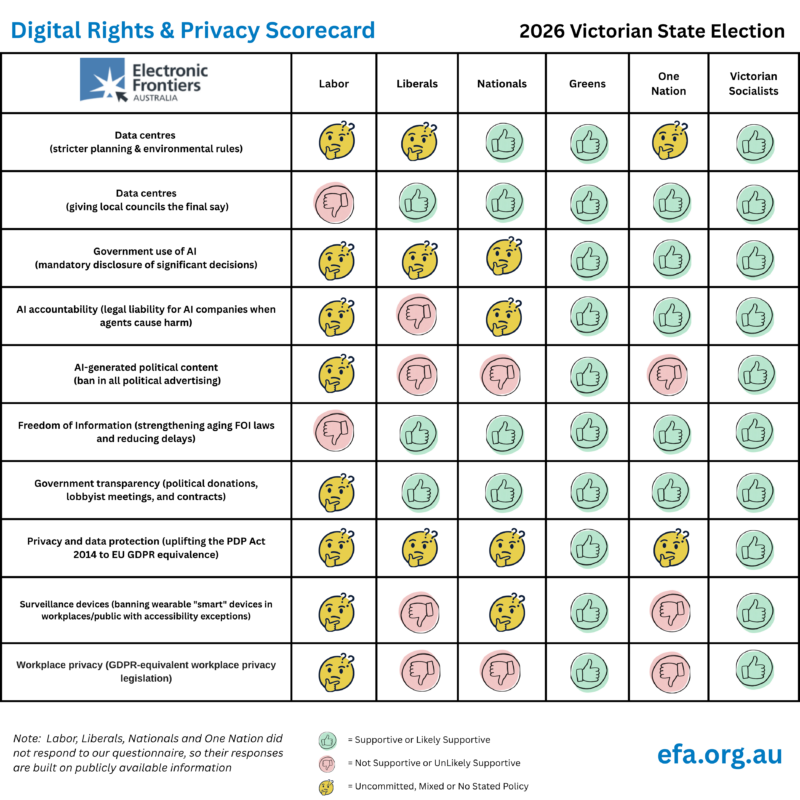
How to read this scorecard
- Thumbs up = the party is supportive, or likely to be supportive, of the position in the question.
- Thumbs down = the party is not supportive, or unlikely to be supportive.
- Thinking face = the party is uncommitted, has given mixed signals, or has no stated policy on the question.
For the Greens and the Victorian Socialists, every marker reflects what the party itself told us in writing. For Labor, the Liberals, the Nationals and One Nation, markers are our assessment of publicly available information, because those parties did not respond to the questionnaire. Where a party is marked as uncommitted, that means we could not find a clear public position (not that the party opposes the measure).
If any party would like to correct the record, we will publish their answers. The questionnaire is still open.
What the parties told us
Victorian Greens: Yes to all ten questions, with comments on data centres, privacy law reform and workplace privacy, and a pointer to their AI and data centres platform. In their own words:
- On data centres: “The Greens are calling for a moratorium on new data centres to determine what parameters are required, including the most appropriate planning processes. We believe it’s vital that local governments and communities have a say in whether or not a data centre is built in their area, and there should be rigorous and genuine community consultation. But there also needs to be strong state government oversight given the potential scale and impact (eg on energy and water use) that needs to be managed.”
- On privacy law reform: “The Greens support improvements to the Privacy and Data Protection Act 2014 to bring it in line with the European Union’s General Data Protection Act (2018).”
- On workplace privacy: “The Greens would support the introduction of legislation that improved employee privacy in the workplace to a level equivalent to the European Union’s General Data Protection Act (2018).”
Victorian Socialists: Yes to all ten questions, without further comment.
Labor, the Liberal Party, the Nationals and One Nation: No response received by the deadline of 5:00 PM on 15 November 2026.
What the public record shows
For the four parties that did not respond, here is the short version of what we found.
- Labor, as the party of government, has the clearest record to assess, and it is the weakest on this scorecard. We could find no question on which Labor is clearly supportive. It is unsupportive on giving local councils the final say over data centre developments, and on strengthening Victoria’s ageing freedom of information laws. On the remaining eight questions, including bringing the Privacy and Data Protection Act 2014 up to GDPR standard, disclosing government use of AI, and workplace privacy, there is no clear commitment either way.
- The Liberals are supportive on local council planning powers, freedom of information reform and government transparency, and unsupportive on AI accountability, AI in political advertising, surveillance devices and workplace privacy. Their position on data centre planning rules, government use of AI and privacy law reform is unclear.
- The Nationals are supportive on both data centre questions, freedom of information and transparency, and unsupportive on AI in political advertising and workplace privacy. They are uncommitted on government use of AI, AI accountability, privacy law reform and surveillance devices.
- One Nation is supportive on local council planning powers, disclosure of government AI use, AI accountability, freedom of information and transparency, and unsupportive on banning AI-generated political advertising, restricting surveillance devices and workplace privacy protections.
The ten questions
1. Should data centres be subject to stricter planning and environmental rules?
2. Should local councils have the final say on data centre developments in their area?
3. Should government use of AI in significant decisions be subject to mandatory disclosure?
4. Should AI companies face legal liability when their agents cause harm?
5. Should AI-generated content be banned in all political advertising?
6. Should Victoria’s ageing FOI laws be strengthened and delays reduced?
7. Should government transparency be improved on political donations, lobbyist meetings and contracts?
8. Should the Privacy and Data Protection Act 2014 be uplifted to EU GDPR equivalence?
9. Should wearable “smart” surveillance devices be banned in workplaces and public spaces, with accessibility exceptions?
10. Should Victoria introduce GDPR-equivalent workplace privacy legislation?
Where to get voting information
Enrolment, voting centres, early voting and postal voting are all handled by the Victorian Electoral Commission. Everything you need is at vec.vic.gov.au.